
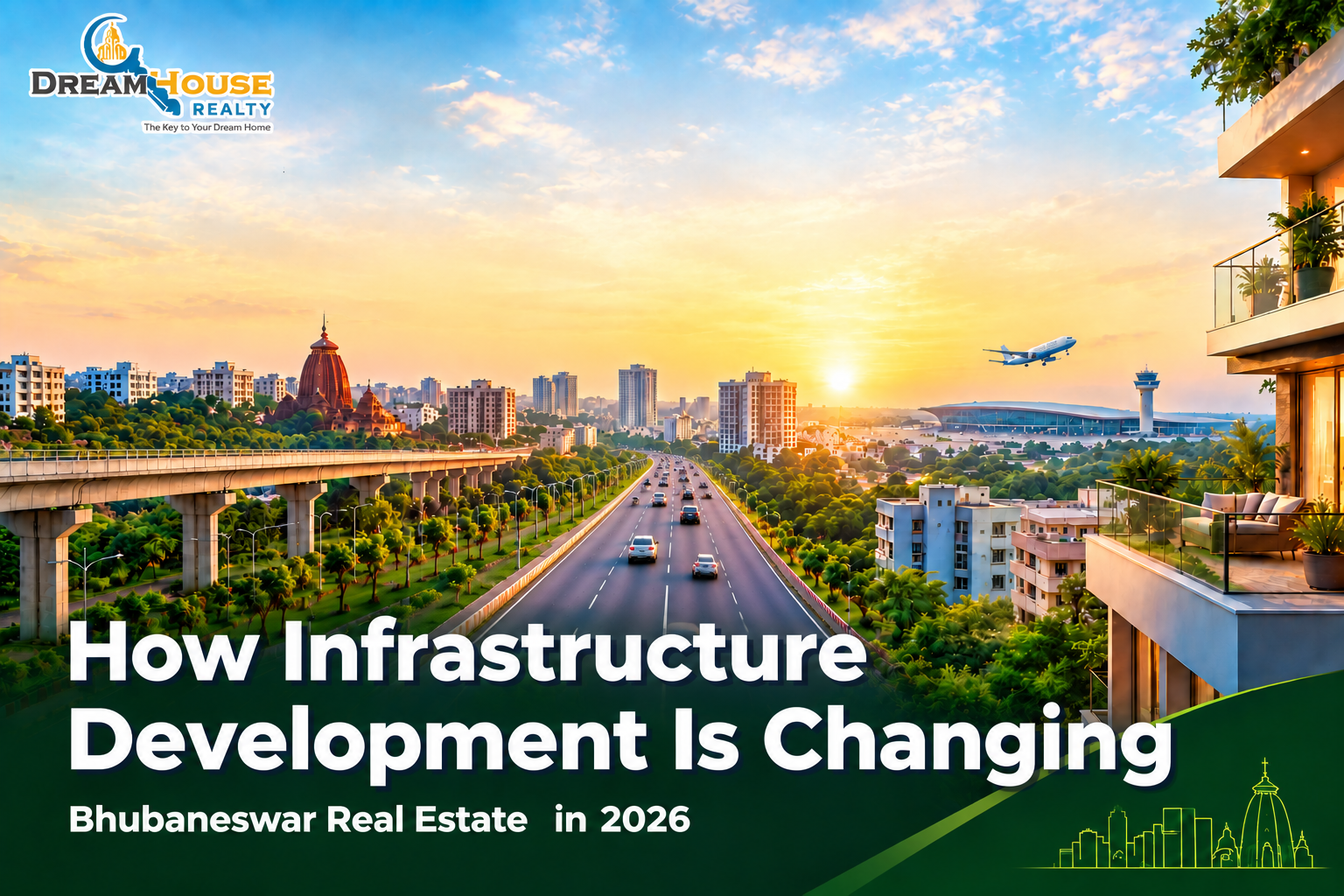
How Infrastructure Development Is Changing Bhubaneswar Real Estate in 2026
Bhubaneswar is rapidly evolving from a traditional administrative capital into a larger economic, residential and investment hub. In 2026, infrastructure development is playing an increasingly important role in shaping where people live, where businesses expand and where new residential projects are being developed.
The broader Bhubaneswar-Cuttack-Puri-Pradeep Economic Region (BCPPER) is now part of a strategic regional development plan that focuses on connectivity, urban expansion, technology, tourism, industry and real estate. NITI Aayog’s 2026 economic plan identifies infrastructure and planned urban expansion as important drivers of future real-estate demand.
Better Road Connectivity Is Expanding Residential Growth:
Road connectivity is one of the biggest factors influencing real estate development.
A major development in 2026 is the 111-km Capital Region Ring Road, also known as the Bhubaneswar Bypass. NHAI awarded contracts in March 2026 for the six-lane, access-controlled greenfield project, which is planned from Rameshwar to Tangi. The project is expected to improve regional connectivity and create better links around the capital region.
For real estate, improved road connectivity can make peripheral and emerging locations more accessible to residents, businesses and investors.
This is encouraging developers to look beyond established city centres and consider new residential corridors with better connectivity.
Emerging Locations Are Becoming More Important:
As Bhubaneswar expands, homebuyers are increasingly looking at areas outside the traditional city core.
Locations connected to major roads, employment centres, educational institutions and upcoming infrastructure can attract residential development because buyers often consider both the present accessibility and the potential future development of an area.
The NITI Aayog economic plan specifically identifies new planned or expanding urban/suburban growth zones, greenfield townships along the outer ring road and satellite-city development as opportunities for the region’s real-estate sector.
Transit-Oriented Development Could Reshape Property Demand:
Another important trend is Transit-Oriented Development (TOD).
The 2026 BCPPER plan recommends a TOD policy for the region, with compact, mixed-use and pedestrian-friendly development around major transit corridors. It suggests focusing development within approximately 500–800 metres of major transit stations to improve accessibility and reduce travel distances.
If implemented, this approach could influence the location and design of future residential and commercial projects.
Instead of isolated housing projects, future development could increasingly combine:
- Residential apartments
- Retail spaces
- Offices
- Recreational facilities
- Public transport access
- Walkable neighbourhoods
IT, Education and Employment Are Supporting Housing Demand:
Infrastructure alone does not create a real-estate market. Employment and economic activity are equally important.
The BCPPER plan positions Bhubaneswar and Cuttack as important knowledge, IT and services centres, while highlighting education, technology and other service-sector activities as growth engines.
As employment opportunities expand, demand can also grow for:
- Apartments close to workplaces
- Rental housing
- Family homes
- Premium residential projects
- Co-living and student accommodation
- Commercial and mixed-use developments
This makes connectivity between residential neighbourhoods and employment hubs increasingly important for homebuyers.
Airport and Regional Connectivity Can Influence Premium Housing:
Improved connectivity also supports business travel, tourism and professional mobility.
For premium homebuyers, proximity to major roads, airports, business districts and commercial centres can become an important consideration.
Bhubaneswar’s role within the wider BCPPER means the city is increasingly being viewed as part of a connected regional economic system rather than as an isolated urban centre. The 2026 plan integrates Bhubaneswar, Cuttack, Puri and Paradeep through coordinated infrastructure and economic development.
Infrastructure Is Creating Opportunities for New Townships:
One of the most significant potential changes is the movement toward planned urban expansion.
The BCPPER real-estate strategy proposes new planned satellite cities for Bhubaneswar and greenfield townships along the outer ring road, with residential, commercial and institutional infrastructure integrated into these developments.
This could gradually change the way Bhubaneswar grows.
Rather than concentrating all development in the existing urban core, future growth may spread toward well-connected suburban and peripheral areas.
For buyers, this makes it important to evaluate not just the current surroundings of a property but also:
- Road connectivity
- Planned infrastructure
- Nearby employment hubs
- Schools and hospitals
- Retail and lifestyle facilities
- Public transportation
- Future development plans
- RERA registration and project approvals
Real Estate Is Becoming Part of a Larger Economic Ecosystem:
Real estate is no longer simply about constructing residential buildings.
The 2026 BCPPER plan identifies real estate as an important sector supporting education, industry, services, tourism and overall quality of life. It also highlights opportunities for affordable housing, rental housing, smart and green infrastructure, commercial development and mixed-use projects.
This means future property demand in Bhubaneswar could increasingly be connected to the growth of the wider economy.
The Future of Bhubaneswar Real Estate:
Bhubaneswar’s real-estate landscape is gradually being shaped by a combination of road connectivity, regional planning, employment growth, urban expansion and infrastructure investment.
The 2026 BCPPER roadmap goes further by proposing satellite cities, greenfield townships, transit-oriented development and improved regional mobility. These are planning proposals rather than guaranteed outcomes, and their timing will depend on detailed feasibility, approvals and implementation.
For homebuyers and investors, the key lesson is simple: location should be evaluated not only by what exists today, but also by verified infrastructure and development plans that can influence the area in the future.
Looking for Property in Bhubaneswar?
At Dream House Realty, we help homebuyers explore residential properties across Bhubaneswar and surrounding growth corridors.
From understanding project details and comparing properties to arranging site visits, our team helps buyers make more informed property decisions.
Dream House Realty – Turning Dreams into Addresses.